Over the past few years, an increasing number of waste, recycling and refuse operators have been switching their vehicle fleets from diesel to electric.
These all-electric trucks, which provide a less stressful environment for drivers, reduce noise and air pollution in densely populated areas, by providing near-silent operation and zero tailpipe emissions.
In addition, organisations looking to achieve their decarbonisation goals are being helped by the excellent and growing range of trucks on offer from vehicle manufacturers and specialist bodybuilders.
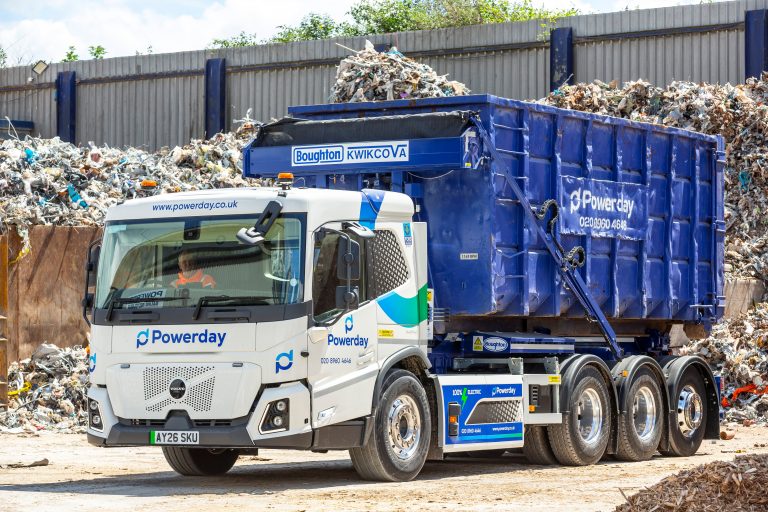
For example, London-based waste and recycling management company Powerday recently took delivery of two electric Volvo FM Low Entry hookloaders.
Supplied by Volvo Truck and Bus South & East, the new additions, fitted with Boughton hookloader bodywork, are used to support waste and recycling operations across London.
Each five-star Direct Vision Standard-rated Volvo FM Low Entry rigid is equipped with four traction batteries, delivering a total battery capacity of 360 kWh.
Built on Volvo’s FM platform, the battery-electric cab has been lowered and moved forward to improve direct visibility for drivers, while a low entry step and flat floor make access easier and safer for city-based waste and recycling work.
Onboard safety technologies include Adaptive Cruise Control with Forward Collision Warning and Advanced Emergency Braking, Driver Alert Support, Lane Departure Warning, Lane Change Support and Side Collision Avoidance Support systems, as well as Volvo Dynamic Steering.
Volvo Truck and Bus Centre South & East also worked closely with Powerday to conduct detailed route simulations, ensuring the trucks were configured with the most suitable battery capacity and performance characteristics for their intended duties.
The new EVs are charged using the company’s existing 150 kW DC charging infrastructure at its Willesden Junction facility in London, and each vehicle is expected to cover up to 30,000 kilometres per year as part of Powerday’s operations.
Both trucks are covered by a five-year Volvo Gold repair & maintenance contract, and the agreement includes a performance guarantee for the traction batteries beyond the standard two-year warranty supplied with the vehicles.
Edward Crossan, CEO of Powerday, said: “The FM Low Entry gives us a strong platform to move faster on safety and sustainability simultaneously, reinforcing our drive to cut emissions while improving how we work.
“In a carbon intensive transport environment, progress comes from innovation and the willingness to adopt new technology early, and we see Volvo Trucks as the ideal collaborator in achieving our decarbonisation goals.”
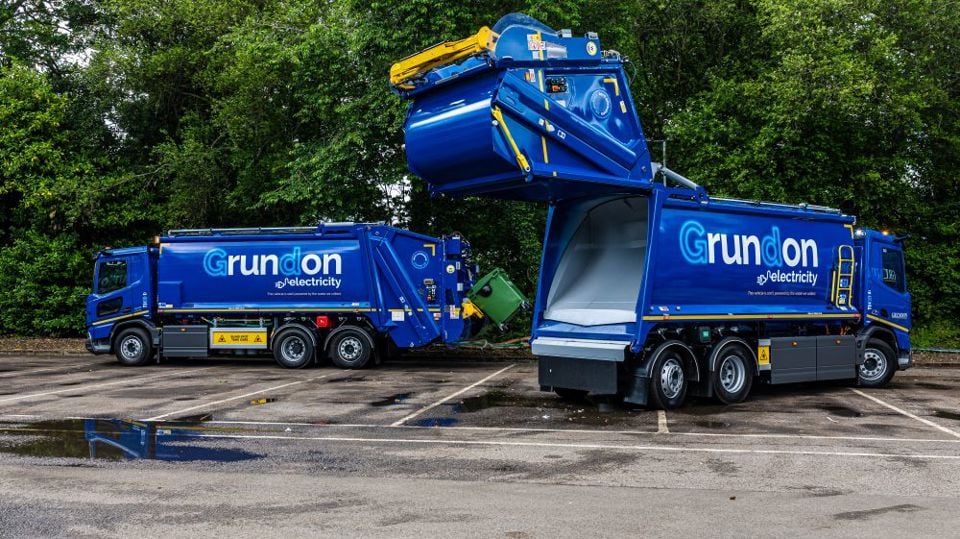
Also, Grundon Waste Management has just taken delivery of its largest battery electric vehicle truck order to date – four DAF XD FAN 270 Electric 6×2 rear steer rigid chassis with specialist trade waste collection bodies.
The new vehicles, which all feature bespoke bodywork from Dennis Eagle, operate out of the company’s Colnbrook facility near Slough.
They carry 420kWh of stored energy, which equates to about 370kWh useable, giving a range in excess of 200 miles on a full charge.
The order takes the current number of electric trade waste vehicles on the fleet – including several repowered trucks – to ten.
Colnbrook is also home to Grundon’s own power supply, responsible for recharging the EVs.
The four new DAFs will soon be joined by five more XD Electrics that will run with a slightly smaller battery pack and be used as part of Grundon’s waste operations powered by the waste they collect.
Stephen Townsend, Group Fleet Engineer at Grundon Waste Management said: “We generate our own power by recovering energy from non-recyclable waste we’ve collected and turning it into electricity to power the trucks.”
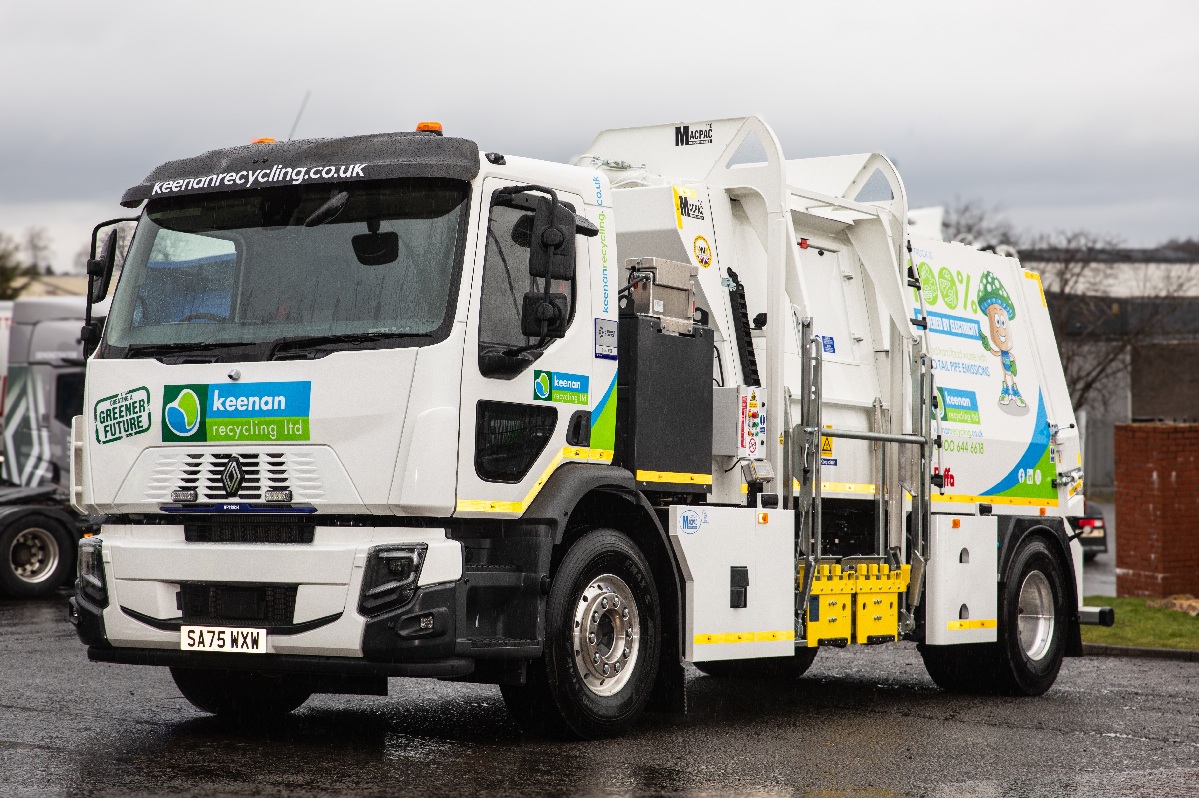
Meanwhile, Keenan Recycling, a Biffa company, has put a fully electric food waste collection vehicle into service.
The new 20-tonne fully electric Renault Trucks D18 Wide chassis, fitted with a specialist Macpac 110 food waste body, operates across Glasgow and the Central Belt.
With an estimated 6.5-tonne payload, the vehicle has been engineered to meet the demanding requirements of food waste collections, and features a special battery relocation behind the cab to allow a side-loader food waste body.
There are four 94kWh batteries – 300kWh usable energy – with a real-world range of just under 180km per charge.
Aaron Davison, Sales Engineer for Electromobility, Renault Trucks UK & Ireland, said: “The side-mounted battery configuration was a first for Renault Trucks in the UK, and demonstrates the strong collaboration between our teams, working together with Macpac and Biffa to deliver the right vehicle solution for food waste collection.
“With zero tailpipe emissions, low noise and excellent manoeuvrability, it is ideal for operating in busy urban environments while delivering significant CO₂ reduction compared to diesel.”
Salford City Council has also introduced an all-electric, 27-tonne Mercedes-Benz eEconic refuse collection vehicle (RCV) to its fleet.
The eEconic combines zero emissions with a high payload capacity similar to its diesel counterpart and an operational range of at least 150km in refuse operations, making it suited to the stop-start demands of urban refuse collection.
It was selected after an extensive evaluation programme when it completed daily rounds on a single charge and returned to the depot with 40 to 60% spare battery capacity.
At 27 tonnes when fully loaded – only one tonne more than the typical 26-tonne diesel equivalent – the eEconic handles more than 1,200 bins per day as part of the council’s 36-truck fleet.
Salford City Council is targeting net-zero by 2038 through natural fleet replacement where possible.
Alan Fitzsimons, Transport Manager at Salford City Council, said: “The vehicle is 100% electric, and the range and regenerative braking are excellent.
“It has surpassed all our expectations and we’re proud to lead the way in sustainable waste collection for Salford residents.”
All these examples highlight the excellent performance, reliability, and day-to-day usability of electric vehicles in waste and recycling operations, and show that they will play a key role in shaping a more sustainable future.