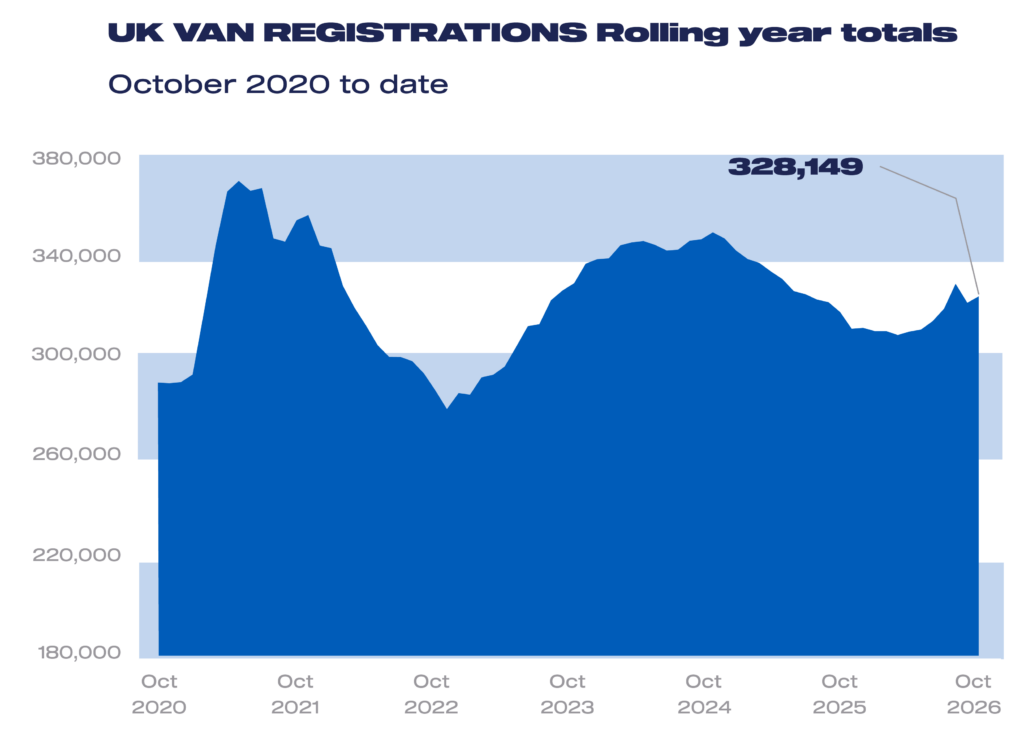
- New light commercial vehicle market up 11.4% in October, rising for seventh month in a row.
- Record October for BEV uptake, up 58.0% to deliver the best percentage uplift of 2026.
- Year-to-date BEV share still less than half ZEV Mandate target for 2026 with latest industry outlook expecting gap to widen in 2027 and 2028.
- Mandate review must urgently bring meaningful change to assure market and industry viability.
Data download
new LCV registrations October 2026
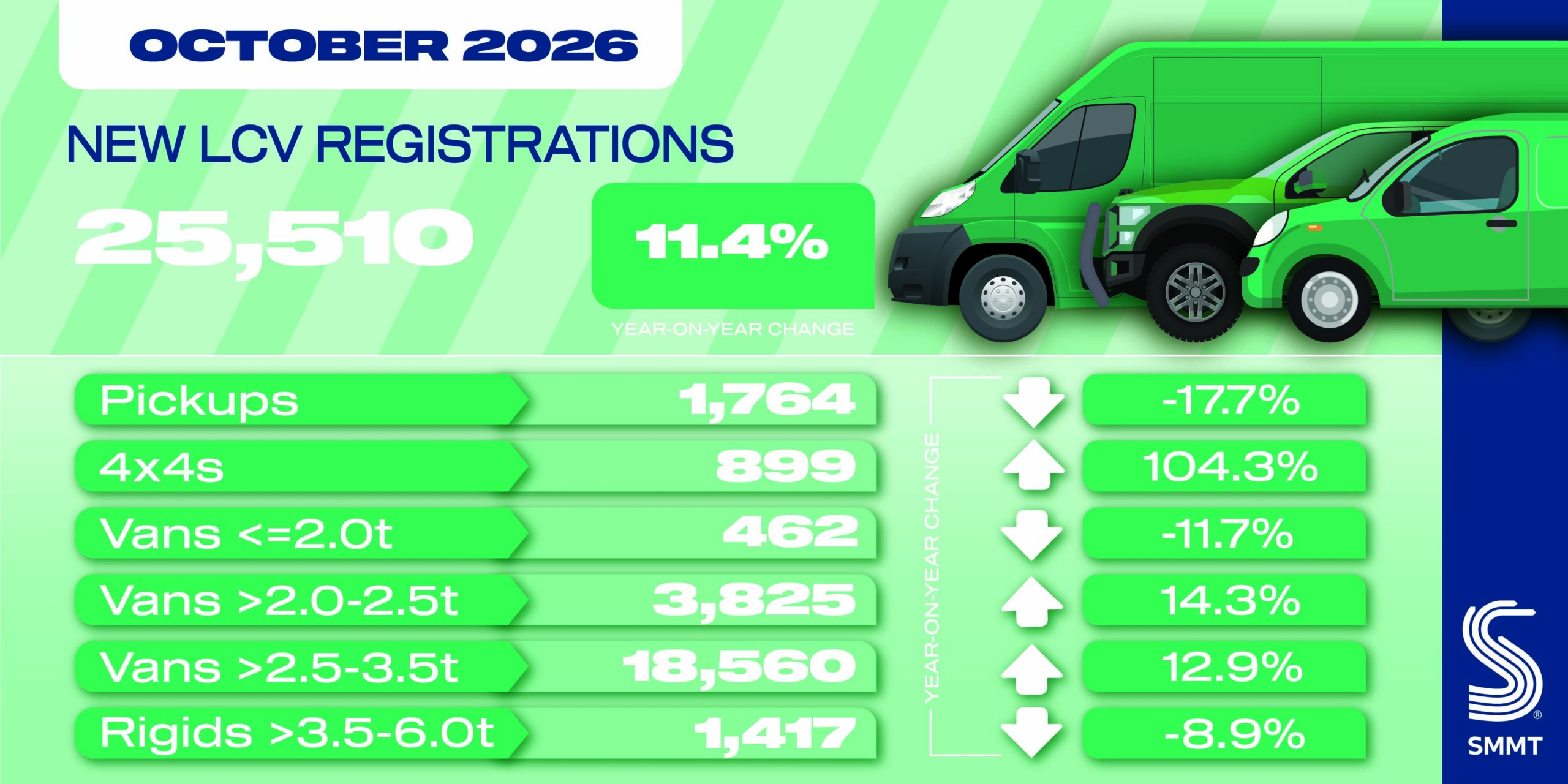
The new light commercial vehicle (LCV) market grew 11.4% in October with 25,510 vans, pickups and 4x4s joining the road, according to the latest figures published today by the Society of Motor Manufacturers and Traders (SMMT). The performance delivered the market’s seventh consecutive month of growth with year-to-date volumes up 4.8% to 276,885 registrations.
Large vans continued to deliver the bulk of volume growth, up 12.9% to 18,560 units in October – representing 72.8% of the overall market – while medium vans rose by 14.3% to 3,825 units. 4x4s achieved the largest percentage increase, more than doubling (up 104.3%) to 899 units. There were declines, however, with small van deliveries down -11.7% to 462 units and pickup registrations falling -17.7% to 1,764 units. Pickup demand remains far weaker across the year, down -52.9% on the same period in 2025 after tax changes to treat double-cabs as cars for benefit-in-kind and capital allowance purposes.1
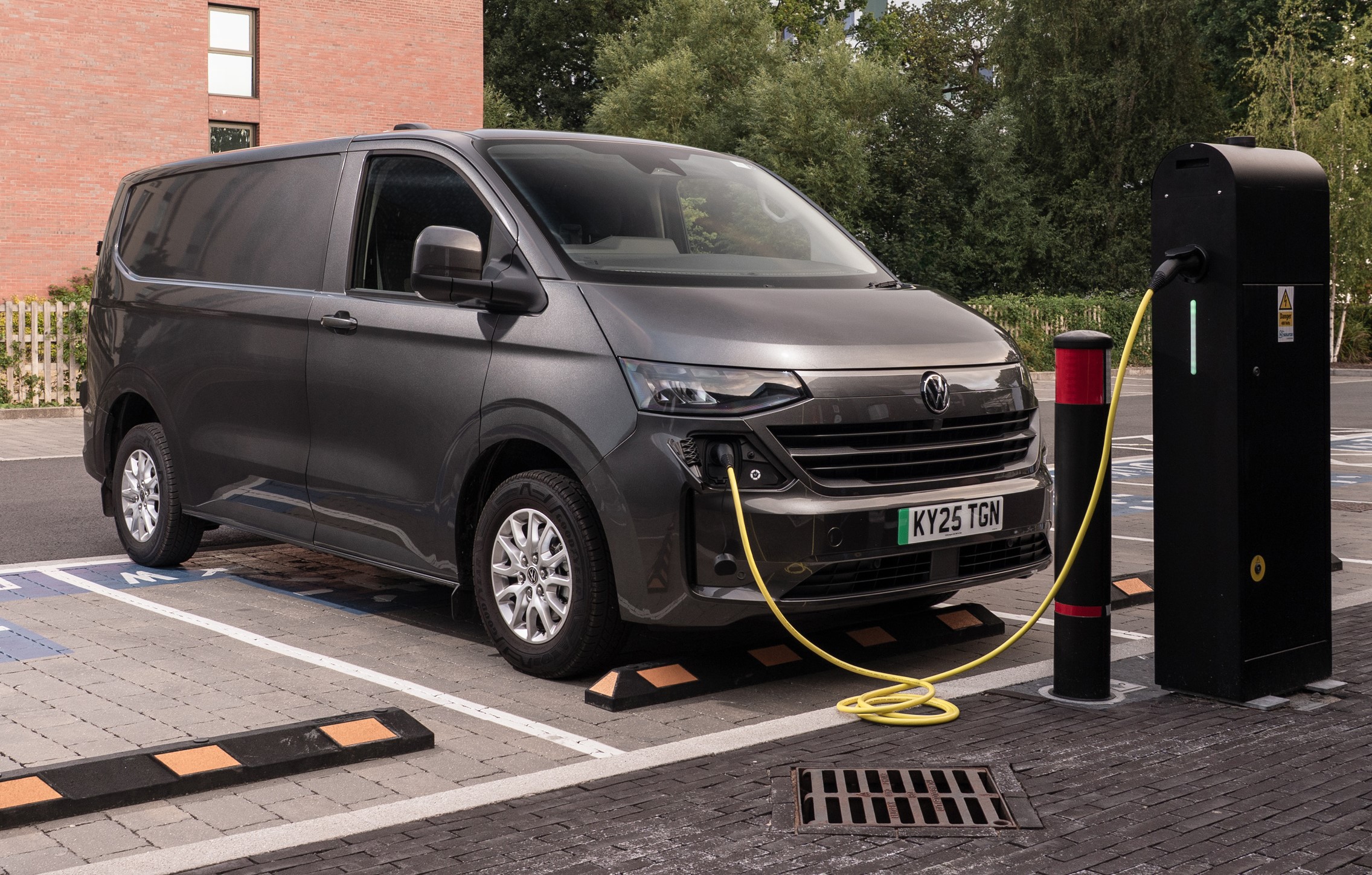
More positively, battery electric van (BEV)2 uptake achieved its best ever October, up 58.0% to 3,369 registrations and a 12.9% market share – bolstering the year-to-date share at 11.0%. This is significant growth, driven by more than 40 different zero emission models, capable of meeting most operator needs. Government’s Plug-in Van Grant and Depot Charging Scheme have also provided essential support to buyers but, still, manufacturers have been forced to provide heavy discounts to avoid even more punitive ZEV Mandate compliance costs.
The latest industry outlook for the overall new LCV market expects 4.2% growth to 329,000 units this year, with BEVs weighing up to 3.5 tonnes achieving a 10.4% share – 13.6 percentage points off the 24% mandated target. Further BEV growth is expected in the medium term, reaching a 14.9% share in 2027 and 18.8% in 2028, but still less than half the respective 34% and 46% annual targets, with the gap only widening.
Government’s mandate review must deliver significant change and do so urgently. A more realistic trajectory is needed to avoid future market uncertainty, protect new product investment, and ensure competitive model choice – all of which are crucial to remove older, more polluting vans from the road sooner. A long-term commitment to purchase incentives is also fundamental to bolster operator confidence, while rollout of LCV-suitable public charging needs to grow rapidly. Lengthy waits for depot grid connections, meanwhile, must be addressed and deserve prioritisation under plans for GB Grid, given the sector’s critical role in driving the UK economy and decarbonisation.
Mike Hawes, SMMT Chief Executive
Seven months of new van market growth reflects a slight recovery in buyer confidence after 2025, but the fragility of this confidence makes the EV transition particularly tough to deliver. While electric van uptake is accelerating rapidly, demand remains far behind the optimistic and unrealistic expectations of the mandate. Government’s review must provide clear and meaningful trajectory change before the year ends, not marginal tinkering, to avoid damaging the market, and the businesses and economic growth which depend on this sector.
Notes to editors
- HMRC, Car benefit: double cab pickups 6 April 2025 onwards.
- SMMT’s new BEV LCV registration data reflects the Vehicle Emissions Trading Scheme, in which BEVs weighing >3.5-4.25t contribute towards each manufacturer’s target, in addition to those weighing ≤3.5t.
SMMT Update
Sign up
Sign up to the SMMT Update Newsletter for weekly automotive news and data
"*" indicates required fields