- Industry warns decisive action needed now to protect UK automotive competitiveness, investment and jobs, and unlock growth.
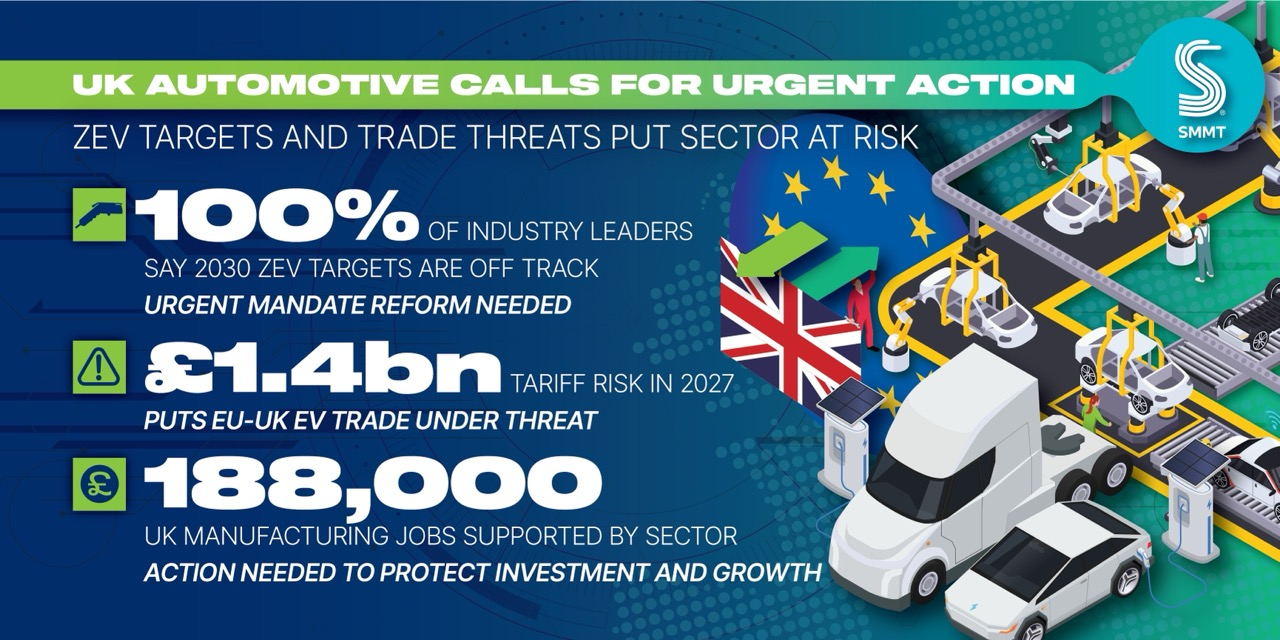
- Immediate review of ZEV Mandate required to align regulation with market reality as 100% of industry leaders responding to new survey say 2030 ambition is behind target.
- EU-UK trade threatened by Made in Europe proposals and c£1.4bn 2027 EV tariff hit unless agreement reached on EU Industrial Accelerator Act and tougher Brexit deal rules of origin.
- New SMMT report welcomes progress on industrial strategy and sets out a blueprint for next Prime Minister to safeguard sector supporting 188,000 manufacturing workers.
Britain must act now to secure the future of its world-class automotive industry, the Society of Motor Manufacturers and Traders (SMMT) is warning today, with urgent action needed for a sector under pressure from mounting costs, global protectionism and rising risk of disinvestment.
Speaking at the SMMT International Automotive Summit in London, Chief Executive Mike Hawes welcomed progress in the first year of the Modern Industrial Strategy but said there must now be an unrelenting focus on delivery. Urgent decisions are needed to make the transition to zero emission vehicles achievable, keep EU-UK trade open and make the UK more competitive as a place to invest, build, sell, export and grow.
SMMT’s latest State of the Automotive Nation report, published today and featuring the second UK Automotive Business Leaders Barometer, sets out a ‘blueprint’ for the next Prime Minister. It argues that one of the UK’s most strategically important high-value sectors can return to growth, but only if government moves quickly to remove the barriers holding it back.
The report welcomes recent progress, including £4 billion of DRIVE35 funding; action on industrial electricity costs through the British Industrial Competitiveness Scheme (BICS); trade deals with the US, India and the GCC; EV grants; and regulation to support self-driving vehicles. But it warns that these gains will be undermined unless three major issues are addressed: reform of the ZEV Mandate, securing fair UK-EU trade, and cutting the underlying energy and business costs that shape investment decisions.1
The most immediate concern is the ZEV Mandate. Manufacturers are committed to net zero and have invested billions of pounds in new zero emission technology and models, but the regulation is running ahead of natural market demand. This is forcing companies to subsidise the market at unsustainable levels, undermining residual values and weakening the UK as both a market and a manufacturing base. Every business leader responding to the survey said the UK is behind the trajectory needed to meet the 2030 target, with almost three-quarters (73.8%) saying it is significantly behind.2
The pressure will increase sharply from January 2027, when annual targets rise to 38% BEV (battery electric vehicle) sales for cars and 34% for vans, before climbing again to 52% and 46% respectively in 2028. Current market shares are 23.9% for cars and 9.5% for vans.3 Car makers alone have already spent more than £12 billion on discounts to stimulate demand – money that could otherwise have supported new models, jobs and investment.4
A second threat is approaching fast, as the UK risks being effectively shut out of its biggest market – the EU. ‘Made in Europe’ proposals put forward by the European Commission would effectively make UK automotive products uncompetitive in the majority of the European market unless the EU accedes to UK calls for our products to be recognised as “assembled in the EU” for these purposes. Four in five (83.3%) UK automotive business leaders say their UK operations would be hit if the proposals go ahead unchanged,5 and both the UK and EU stand to lose out given the interconnected nature of the sector, with the UK the EU’s biggest automotive export market and vice versa.6
In addition, from January 2027, tougher rules of origin under the EU-UK Trade and Cooperation Agreement will trigger a 10% tariff on some 70% of battery electric and plug-in hybrid models traded across the Channel. Without a joint solution, the sector faces a tariff bill of around £1.4 billion in 2027 alone, putting some £16.4 billion of UK-EU battery electric and plug-in hybrid vehicle trade at risk by making many of these crucial models less competitive and less affordable.7
At home, cost pressures are compounding the challenge. More than nine in 10 businesses (93.5%) say employment costs have worsened over the past year, while 84.8% report higher input costs. While BICS will help, seven in 10 automotive bosses say cutting energy costs would have the most positive impact on their business.8 UK energy costs are still the highest in Europe and, even with BICS, would remain some 60% above the EU average.9 SMMT is, therefore, calling for further action to make the UK a more competitive place to manufacture.
Getting industrial strategy, trade policy and the EV transition right would support government’s ambition for a UK sector building 1.3 million vehicles a year. It would also help maintain and grow Britain’s automotive trade, already worth more than £110 billion in imports and exports annually – while creating a domestic market of 2.2 million vehicles in which zero emission models are the natural choice for most drivers.10
Mike Hawes, SMMT Chief Executive
UK Automotive can drive growth, innovation and net zero, but only if the right decisions are taken now. The Industrial Strategy sets out a plan, but delivery is now what matters. We need open trade with Europe, competitive conditions at home, and a realistic route to grow zero emission vehicle uptake. Reforming the ZEV Mandate is not about weakening ambition; it is about making the transition achievable, protecting investment and ensuring the UK remains a place where automotive businesses can build, sell, export and grow. The window for action is closing, which means we cannot wait for lengthy discussions.
Notes to editors
- State of the Automotive Nation 2026 – A Blueprint for 2030.
- UK Automotive Business Leaders Barometer – SMMT member survey conducted 1 May-2 June 2026 with 50 senior automotive leaders. Respondents represent: £94bn turnover, 113,000 employees and 98.4% of UK vehicle production.
- Market shares Jan-May 2026.
- Based on SMMT analysis of Autotrader data on EV discounts, SMMT estimated fleet discounts and EV car market data, and JATO sales weighted recommended retail price data – cumulative from FY 2024 to end of May 2026.
- UK Automotive Business Leaders Barometer.
- EU urged to bolster, not weaken, relationship with UK Automotive
- SMMT analysis covering expected BEV and PHEV UK-EU imports and exports for 2027 only, with 30% ROO compliance rate and 10% tariff – £1.4bn combined liability for both UK and EU manufacturers.
- UK Automotive Business Leaders Barometer.
- Based on DESNZ international comparison electricity prices (inc taxes) for large industrial users in 2025, UK 24.35p/KWh vs 11.3p/KWh for EU27+UK average. BICS can provide up to 25% discount, reducing UK rate to 18.3p/KWh, still 61.6% above the EU average.
- SMMT Opportunity Auto analysis.
SMMT Update
Sign up
Sign up to the SMMT Update Newsletter for weekly automotive news and data
"*" indicates required fields