How important is the concept of a multi-life tyre policy for Michelin?
A multi-life tyre policy – where a tyre is regrooved once the tread depth reaches 3mm to 4mm, retreaded and ultimately regrooved again to achieve ‘four lives’ – is at the heart of what we deliver for operators, and why they put their faith in us. It can significantly reduce transport companies’ carbon footprints – on average, only 20kg of raw materials are needed to be added to a worn casing, compared with around 70kg of materials per new tyre. It also lowers the total cost of ownership of the fitments as regrooving keeps each tyre in its most fuel-efficient state for longer and maximises the life of each fitment.
The strategy supports skilled UK jobs at our dedicated retread factory in Stoke-on-Trent and is integral to our local-to-local approach (a commitment that every tyre produced at the facility is used within the UK & Ireland). As part of our commitment to progress, we are building an advanced recycling facility adjacent to our factory with Murfitts Industries. This will process end-of-life tyres and repurpose them for other uses.
Describe how a ‘four lives’ approach and Michelin products help local authorities cut their road fleet carbon emissions.
We work with local authorities across the UK through the Crown Commercial Service, a government framework designed to make procurement transparent and smoother. In the case of Mid and East Antrim Borough Council, which has a 160-strong commercial vehicle fleet – from vans to hook loaders and Refuse Collection Vehicles – our partnership has achieved CO2 savings of 27.7 tonnes in the three years up to and including 2025. This has been delivered via a multi-life tyre policy for its HGVs – with over 10 tonnes of material diverted from landfill and 13 fewer tonnes of material used compared with the production of new tyres – as well as moving to our dedicated Michelin Agilis van products.
These tyres feature reinforced sidewalls to protect against kerbing, and since fitting them the local authority has also seen a significant reduction in punctures, which has improved the van fleet’s uptime.
Tell us about the part Michelin tyres played in Volvo Trucks’ recent road test fuel efficiency record?
We have a long relationship with Volvo who trust our products to deliver, and we were extremely proud to see Michelins fitted for their record-breaking run. This saw a Volvo FH Aero and trailer wearing Michelin X-Line Energy tyres, which are designed to deliver optimal fuel efficiency for long distance haulage applications, achieve a record 11.25 miles per gallon on the demanding Commercial Motor road-test route. It was the perfect specification to help the ultra-fuel-efficient Volvo truck surpass the manufacturer’s own previous record by nearly 1.5 mpg and set a new benchmark for real-world fuel economy.
What specialist tyres does Michelin produce for electric buses?
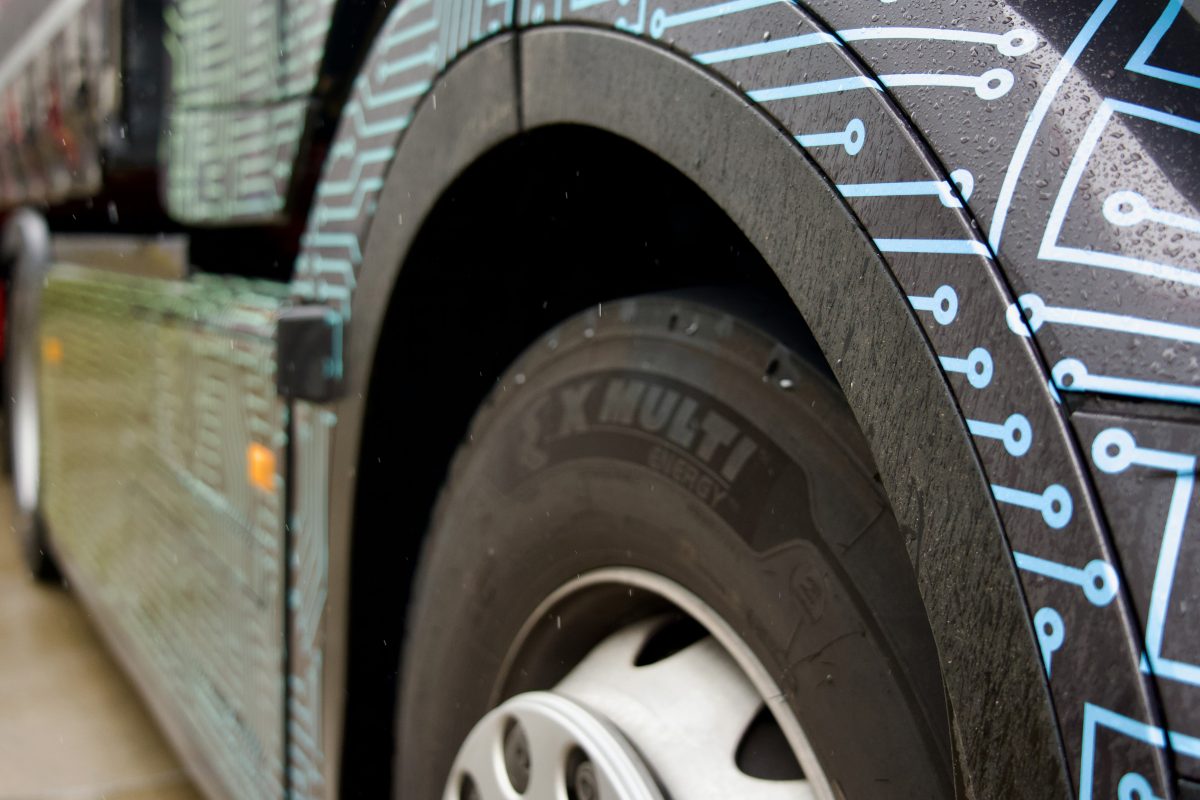
Our primary tyre for electric buses is the Michelin X InCity EV Z, although our tyre technology is powertrain agnostic. The multi position tyres offer excellent safety, which is a non-negotiable for passenger transport, load capacity to deal with today’s heavier vehicles and longevity – they feature increased resistance to sidewall kerb damage and tread splitting – and can be regrooved and retreaded.
X InCity EV Z also reduce rolling resistance,by up to 13% compared with our early generation Michelin InCity XZU, lowering energy consumption. It’s why companies such as McGill’s Group have been proud to work with us for more than 20 years, with Group CEO Tony Williamson citing our commitment to sustainability, which helps them ‘get the absolute maximum from every tyre’ as key to our enduring partnership.

Andrew French
B2B Sales Director, Michelin UK & Ireland