Describe Mahle’s new range extender system
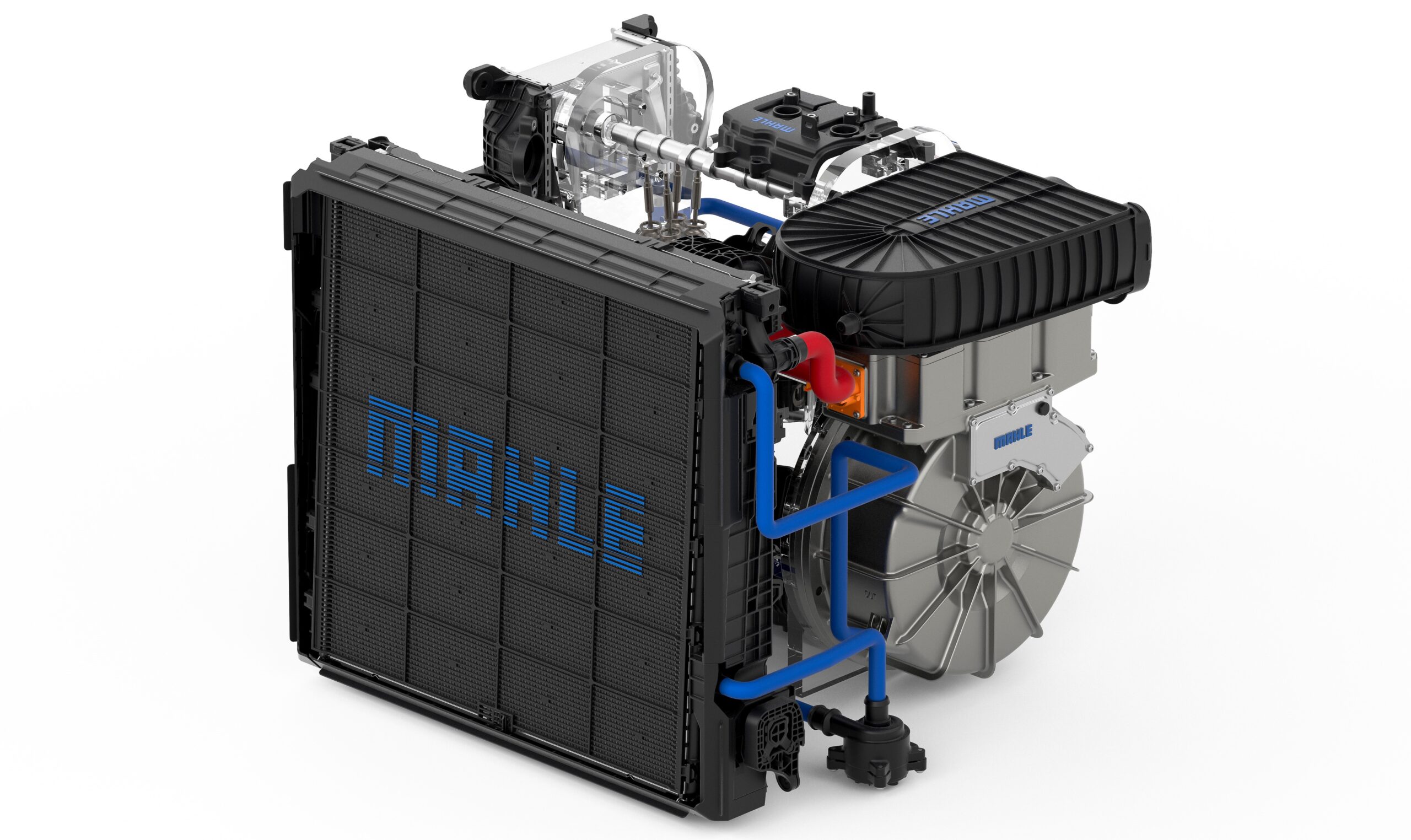
Mahle Group’s new range extender is a compact unit combining a generator, internal combustion engine, thermal management, fuel tank, AdBlue tank and exhaust gas treatment. It can easily be integrated into existing battery-electric vehicle platforms, and the main component is a high-voltage generator with a continuous output of 110 kW and a peak output of up to 130 kW. Thanks to its newly developed advanced oil cooling system, the generator has a power density of more than 7 kW per kilogram. The integrated thermal management system with 48 kW of high-temperature and 15 kW of low-temperature cooling capacity also ensures efficient, reliable operation.
The range extender replaces about one-third of the present battery capacity of a battery-electric truck. As a result, the rear axle load can be reduced by about 400 kilograms and the total vehicle weight by about 600 kilograms. All in all, a BEV truck equipped with this system can reach a total range of more than 800 km (497 miles), with the battery providing about 400 km (249 miles) and the range extender the remaining 400 km (249 miles).
Compared with a conventional drive system, the CO2 emissions in real-life operation can be reduced by more than 80 percent.
Tell us about the Mahle Contactless Transmitter (MCT) electric motor without rare earth elements?
Our new MCT electric motor for electric drive axles of heavy commercial vehicles is not equipped with permanent magnets and therefore does not require any rare earth elements. Compared with a conventional permanent magnet synchronous motor, the MCT electric motor saves up to three kilograms of rare earth magnets per vehicle, thus reducing dependence on critical raw materials.
With a peak output of 370 kW and torque of over 900 Nm, the MCT electric motor offers the high power density needed for demanding applications in heavy truck operations. It also makes the drive system up to 10 kg lighter than comparable solutions, further improving vehicle efficiency.
In the VECTO driving cycle, the motor has an efficiency of 95 percent. In real-life driving cycles covering a wide variety of applications, the drive system reaches higher efficiency levels than comparable permanent-magnet electric motors. The technology therefore combines resource conservation, high performance and energy efficiency in a future-oriented drive system concept for electric commercial vehicles.
What role do renewable fuels play in decarbonising the sector?
Even though the use of internal combustion engines is declining throughout the world, especially in China and Europe, they remain relevant and account for significant volumes in all regions. This is especially the case because the demand in the commercial vehicle sector remains high. This is why Mahle is consistently developing these drive systems for use with renewable fuels such as hydrogen, bio-ethanol, HVO100 or bio-LNG. Especially with respect to existing vehicle fleets, these fuels offer considerable potential for the rapid, large-scale reduction of CO₂ emissions.
Battery-electric drive systems, hydrogen technologies, renewable fuels and range extender systems should supplement each other with a view to achieving climate targets as rapidly and economically as possible.

Arnd Franz
Chairman of the Management Board and CEO of Mahle