- New analysis reveals scale of EU-UK auto interdependency, with UK automotive production directly supporting €24bn of EU economic activity and 250,000 jobs across the bloc.
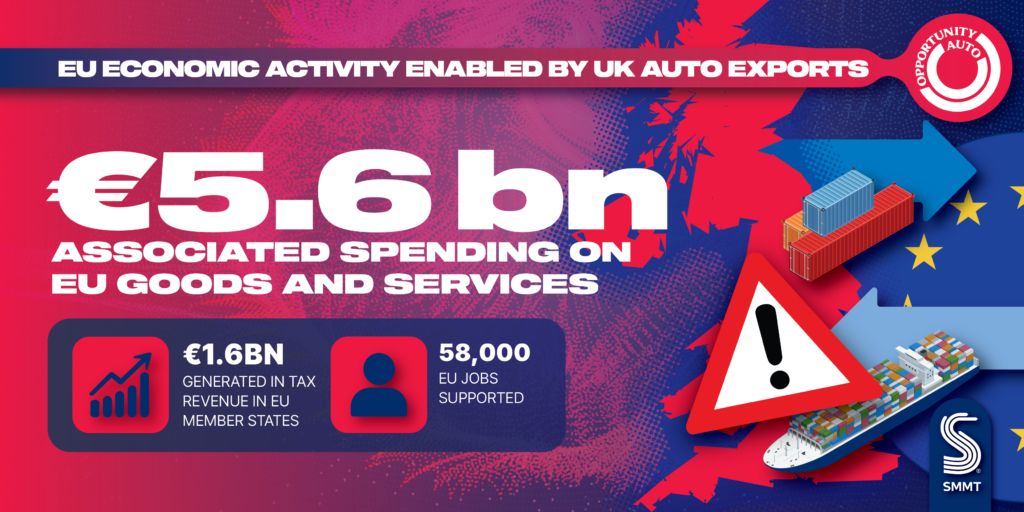
- UK automotive exports to the EU alone drive €5.6bn spend on EU goods and services, supporting 58,000 jobs and €1.6bn in tax revenues.
- As EU talks on the Industrial Accelerator Act intensify, sector warns excluding UK Auto from ‘Made in Europe’ provisions would put shared investment and €80bn trading relationship at risk.
- SMMT urges EU to recognise UK-built vehicles, parts and materials as equivalent to EU products, protecting competitiveness, consumer choice and one of Europe’s most valuable supply chains.
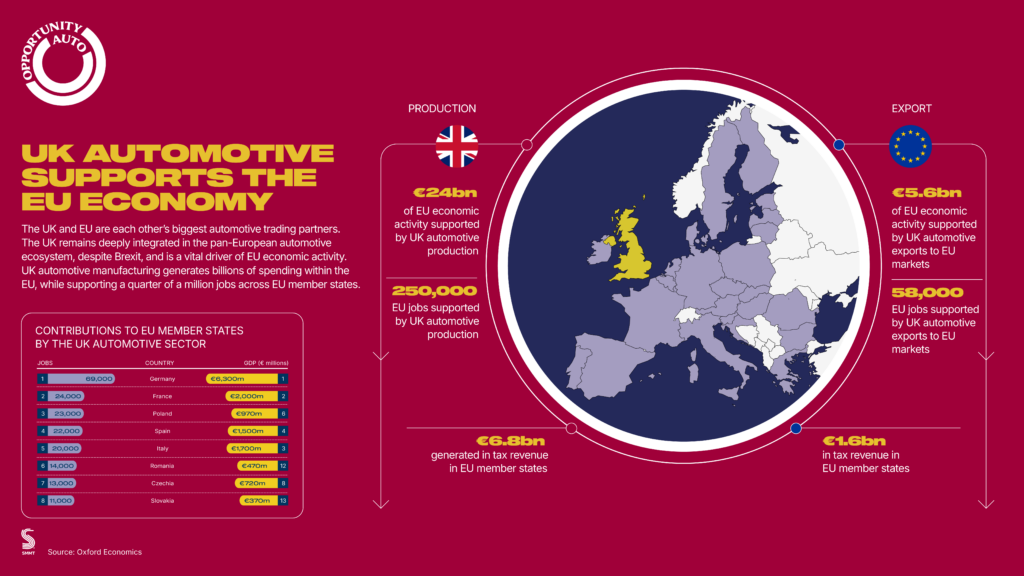
The deep integration of the EU-UK auto manufacturing industry is laid bare in new analysis published today by the Society of Motor Manufacturers and Traders (SMMT), showing the EU’s €24 billion economic stake in UK automotive manufacturing success.1 The findings come as EU talks on its Industrial Accelerator Act (IAA) intensify and highlight the importance of the UK to Europe’s vehicle markets and supply chain.
The UK is the EU’s largest export market for passenger cars and vice versa, while EU manufacturers sell more automotive components to the UK than to any other global market in a trading relationship worth €80 billion annually.2 The analysis, carried out by Oxford Economics, estimates that UK automotive production supports €24 billion of economic activity across the EU, spanning every sector from utilities to financial services and real estate.
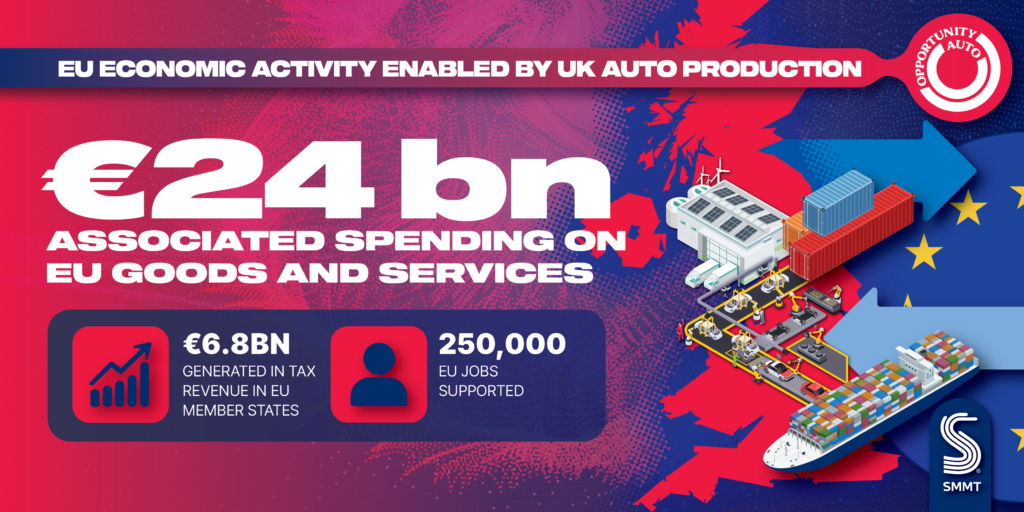
The UK auto sector also sustains 250,000 EU jobs through supply chain activity and wage-funded consumer spending, while UK automotive exports to the EU alone generate €5.6 billion of spending across the bloc, supporting 58,000 jobs and €1.6bn in tax revenues.
These benefits will be put at risk if the IAA excludes the UK from key ‘Made in Europe’ provisions. As drafted, future UK-built vehicles would be denied access to incentives available to EU-built products, including support for greener corporate fleets and CO2 super credits, and be excluded from EU Member State procurement, despite the UK’s role in Europe’s automotive supply chain.
Such an outcome would put UK production at a competitive disadvantage in its largest market, reducing demand for UK-built vehicles and, in turn, reducing UK sourcing of EU components, goods and services. It would also mean higher costs and less choice for European consumers at the very time the sector needs scale, investment and affordability to meet competitive challenges and accelerate the transition to zero emission mobility.
The exposure would be felt across Europe’s major automotive economies, with the biggest GDP impacts in Germany, France, Italy and Spain – at around €6.3 billion, €2 billion, €1.7 billion and €1.5 billion respectively. That economic risk is matched by significant employment exposure, with UK output supporting thousands of jobs in each market, including 69,000 in Germany, 24,000 in France, 22,000 in Spain and 20,000 in Italy. The dependency is even more pronounced in Central and Eastern Europe, where UK automotive production supports 23,000 jobs in Poland, 14,000 in Romania, 13,000 in Czechia and 11,000 in Slovakia – equivalent to as much as 0.46% of total employment in Slovakia and 0.24% in Czechia, reflecting their more labour-intensive industrial bases.
Mike Hawes, SMMT Chief Executive
The EU and UK automotive sectors have traded, invested and grown together over many years. Despite Brexit, supply chains remain deeply integrated and the cross-Channel trading relationship is worth €80 billion a year, supporting jobs, growth and investment. The EU is rightly focused on strengthening its industrial base, but the UK remains fundamental to Europe’s automotive ecosystem and is therefore essential to that ambition. Excluding the UK from ‘Made in Europe’ would be an own goal, weakening competitiveness, reducing scale and limiting consumer choice. We need a better outcome – one that recognises UK Automotive as a trusted partner in the Industrial Accelerator Act and strengthens, rather than fragments, Europe’s automotive industry.
Notes to editors
- Oxford Economics analysis commissioned by SMMT in 2026. Values reflect 2024 unless otherwise stated.
- EU urged to bolster, not weaken, relationship with UK Automotive
- The economic impact assessment estimates European Union activity supported by UK automotive production, including spending on EU-produced goods and services, contribution to EU GDP, tax revenues and jobs supported through indirect supply-chain and induced wage-spending effects.
- The analysis uses SIC/NACE Division 29, covering the manufacture of cars, vans, lorries, coaches and other motor vehicles, together with engines, bodies, trailers and most vehicle parts and accessories. It does not include automotive-related EU supplies made to UK vehicle dealers or other UK customers.
- The analysis shows that €20 billion of UK automotive production exported to the EU supports the €5.6 billion, €4.4 billion and €1.6 billion figures, which measure different things and should not be added together. The €5.6 billion represents spending on EU-produced goods and services associated with UK automotive exports to the EU, comprising around €4.5 billion of supply-chain purchases and €1.1 billion of wage-funded consumer spending. That spending is estimated to support €4.4 billion of EU GDP, while the €1.6 billion tax contribution is estimated separately from the GDP impact using industry- and country-specific tax relationships.
- The €4.4 billion EU GDP impact comprises around €3.3 billion of indirect impact through EU supply chains and €1.1 billion of induced impact through wage-funded consumer spending. Employment is measured on a headcount basis.
- The analysis also shows that in 2024, an estimated £73 billion of UK automotive production supported an estimated €19 billion contribution to EU GDP, 250,000 EU jobs and €6.8 billion of tax revenues in EU Member States. This activity was associated with around €24 billion of spending on EU-produced goods and services.
- The analysis does not model how UK or EU manufacturers, suppliers or customers might respond to a particular policy, nor does it assess precisely which automotive products would fall within the scope of ‘Made in Europe’ provisions. The results should therefore not be interpreted as a forecast of economic loss caused by the proposed policy, but as an estimate of EU economic activity potentially exposed to changes affecting UK automotive exports to EU customers.
- Oxford Economics used its Business Economic Impact Calculator (BEIC), a global input-output model based on established input-output techniques. The model captures relationships between hundreds of industries across more than 6,000 national and local geographies, enabling supply chains to be traced across national borders.
SMMT Update
Sign up to the SMMT Update Newsletter for weekly automotive news and data
"*" indicates required fields