Innovate UK, in partnership with independent technical evaluator WSP, has published the first annual report looking into the Zero Emission HGV and Infrastructure Demonstrator (ZEHID) programme.
Funded by the Department for Transport (DfT) and delivered through Innovate UK, ZEHID is Europe’s largest coordinated demonstration of zero emission HGVs of 40 tonnes or more and the infrastructure that supports them.
The programme aims to create the evidence needed to support future industry investment, infrastructure planning and policymaking through the deployment of battery-electric and hydrogen-powered vehicles in real-world freight operations.
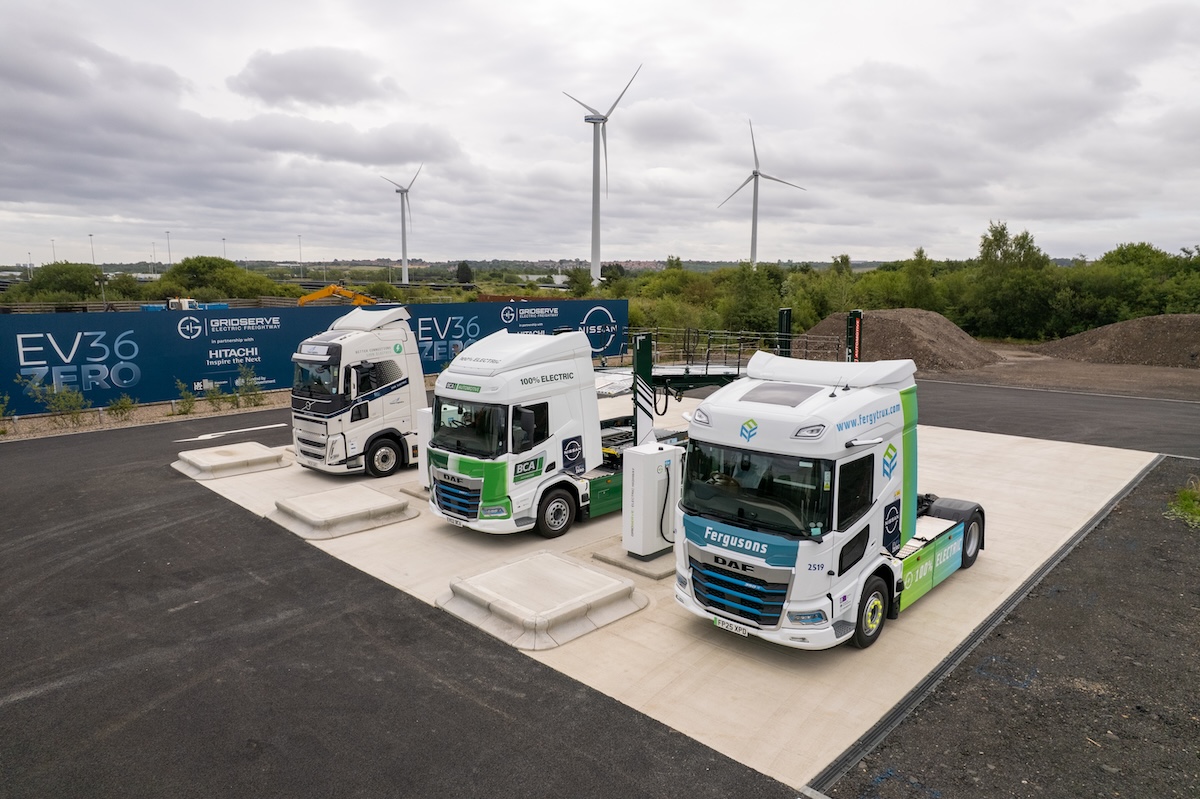
ZEHID’s current projects – Electric Freightway, eFreight 2030 and ZenFreight – have so far put more than 240 zero emission trucks into service and established more than 40 charging sites across the UK.
This figure is expected to rise to about 300 vehicles and 70 infrastructure sites by the end of 2026.
The results also reveal that the HGV trial has covered 2.2 million miles, carrying 550,000 tonnes of freight over 85,000 trips.
According to the initial findings, battery electric HGVs weighing up to 44 tonnes are operating successfully on commercial routes across the whole of the UK.
Monitoring has recorded more than 85,000 trips, 2.2 million miles travelled and more than 550,000 tonnes of freight moved, producing real-world data on zero emission freight vehicle performance.
Claire Spooner, Director of the Innovation Service at Innovate UK, said: “Zero-emission HGVs are already demonstrating their potential in real-world freight operations across the UK.
“This first annual report marks an important milestone for the Zero Emission HGV and Infrastructure Demonstrator (ZEHID) programme, providing valuable insight into what is working, where challenges remain and what will be needed to support the wider transition to zero-emission freight.”
The document also highlights the programme’s environmental benefits, including an approximate 81% reduction in greenhouse gas emissions compared with equivalent diesel operations, as well as cumulative CO₂ savings of more than 4,000 tonnes to date.
The ZEHID programme has now begun a five–year phase of monitoring and evaluation that will run until 2031.
This will produce comprehensive evidence on vehicle performance, infrastructure use, costs, emissions and operational impacts, helping to speed up the switch to cleaner logistics and support the country’s decarbonisation targets.
Sofia Amaral, Business Director for Sustainable Transport at WSP, said: “This first annual report marks an important milestone for the UK’s transition to zero-emission freight.
“Through our role as independent evaluator, WSP is helping to generate robust, real-world evidence on the performance of zero-emission HGVs and supporting infrastructure at unprecedented scale.
“These insights will help industry, investors and policymakers make informed decisions about the future of freight decarbonisation.”
MENZIES DISTRIBUTION SOLUTIONS
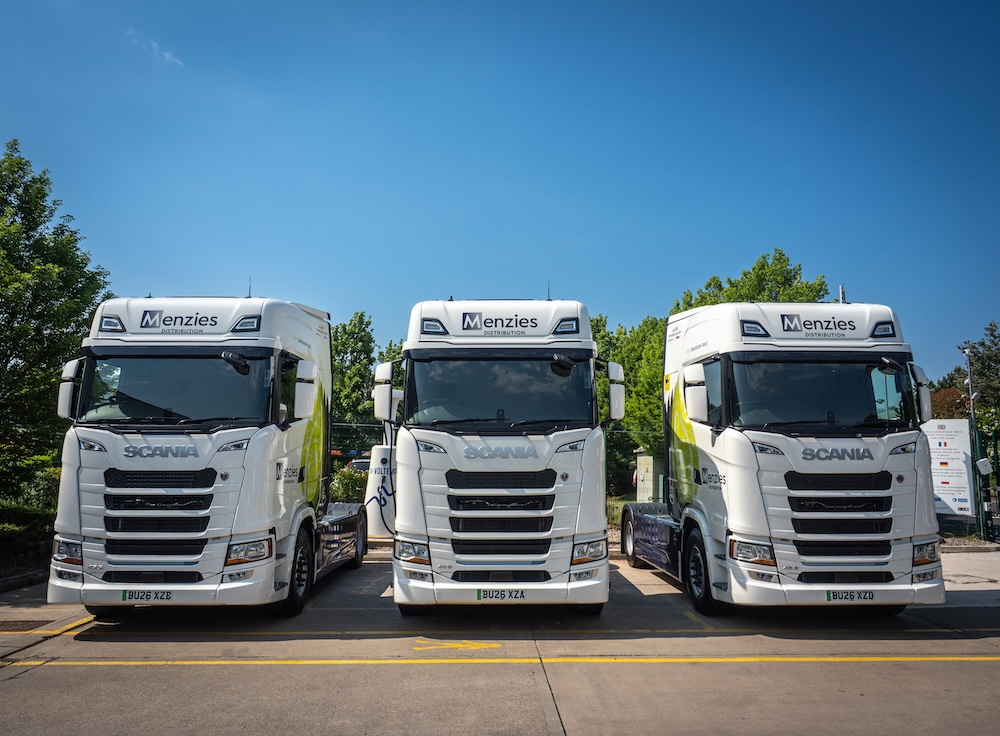
As part of the ZEHID initiative, Menzies Distribution Solutions (MDS) recently put three new 42-tonne Scania electric tractor units into operation, the first of 10 electric HGVs – including vehicles from DAF and Renault Trucks – that it will deploy.
The three Scania 4×2 45S high-roof battery-electric tractor units are based at MDS’s multi-user distribution centre in Wakefield, where they are supporting retail and fast-moving consumer goods (FMCG) deliveries across local and regional routes.
To support the rollout, MDS has invested in on–site charging infrastructure capable of delivering up to 1 MW of charging power.
The company expects each truck to travel about 250 miles per shift and undergo two charging sessions during a typical 24-hour operating cycle.
Voltempo, the eFreight 2030 project lead and charging infrastructure partner, helped MDS with planning and installing the charging network, including grid connection requirements and coordination with the local Distribution Network Operator.
The company intends to expand the vehicles’ role over time, testing them across a variety of routes and operational requirements to better understand their capabilities.
Vehicle telematics will be used to collect data on mileage, energy consumption and operating patterns. The data will be shared with eFreight 2030 and WSP, with anonymised findings contributing to a wider assessment of electric HGV performance across the UK.
Scania worked with MDS during the planning and deployment process, helping to assess route suitability, vehicle specifications, driver training and aftersales support requirements.
MDS plans to use the operational data gathered during the project to shape future investment decisions and identify where battery-electric trucks can be deployed commercially across its network.
Adam Purshall, Fleet, Program and Systems Director at MDS, said: “Our decision to take vehicles from three manufacturers was very deliberate.
“We want to understand how they perform across different routes and duty cycles and generate the operational evidence needed to make informed decisions about future orders and the role battery-electric trucks can play within our fleet.
“Success for us means generating enough evidence to make the right business decisions and support further investment in battery-electric vehicles.”
MARITIME TRANSPORT
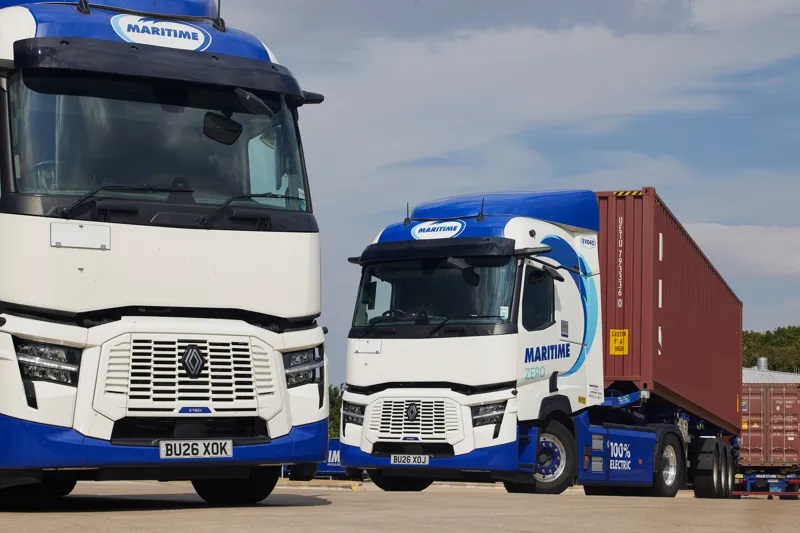
Meanwhile, Maritime Transport has put five Renault Trucks E-Tech T 4×2 tractor units into service through eFreight 2030, with the vehicles forming part of its 56-strong eHGV fleet.
Initial deployments have included the company’s Wakefield and Avonmouth operations, with the trucks set to move around Maritime’s network as its zero-emission operation develops.
At Wakefield, the E-Tech Ts are being used on first and final mile container movements from Maritime’s inland rail terminal.
The five E-Tech Ts will continue to operate throughout the next five-year phase of ZEHID, generating performance data that will help inform the wider programme.
Maritime began introducing eHGVs into its operation in January 2026 and has also deliberately selected vehicles from a range of manufacturers, allowing the business to assess how different trucks perform under day-to-day operating conditions before making longer term fleet decisions.
While the trucks will mainly charge overnight at their inland bases, there are opportunities to charge during the day when energy is often at its cheapest.
Maintenance is handled by Renault Truck Commercials, and the truck manufacturer has worked closely with Maritime on vehicle familiarisation, charging and technical support.
Chris Buck, EV Network Manager at Maritime Transport, said: “The more we run the eHGVs, the greater the potential operational and environmental benefit. “We want to understand how far we can push them within the applications they are suited to, while continuing to learn where electric trucks can deliver most effectively.”