- New car market rises 7.1% in May in best performance for the month since 2019.
- Private buyer demand rises 17.2% as market reinvigorated by wider choice and competitive deals.
- BEVs deliver biggest growth with market share reaching 27.3% but still short of mandated 33% target.
Data download
New car registrations data May 2026
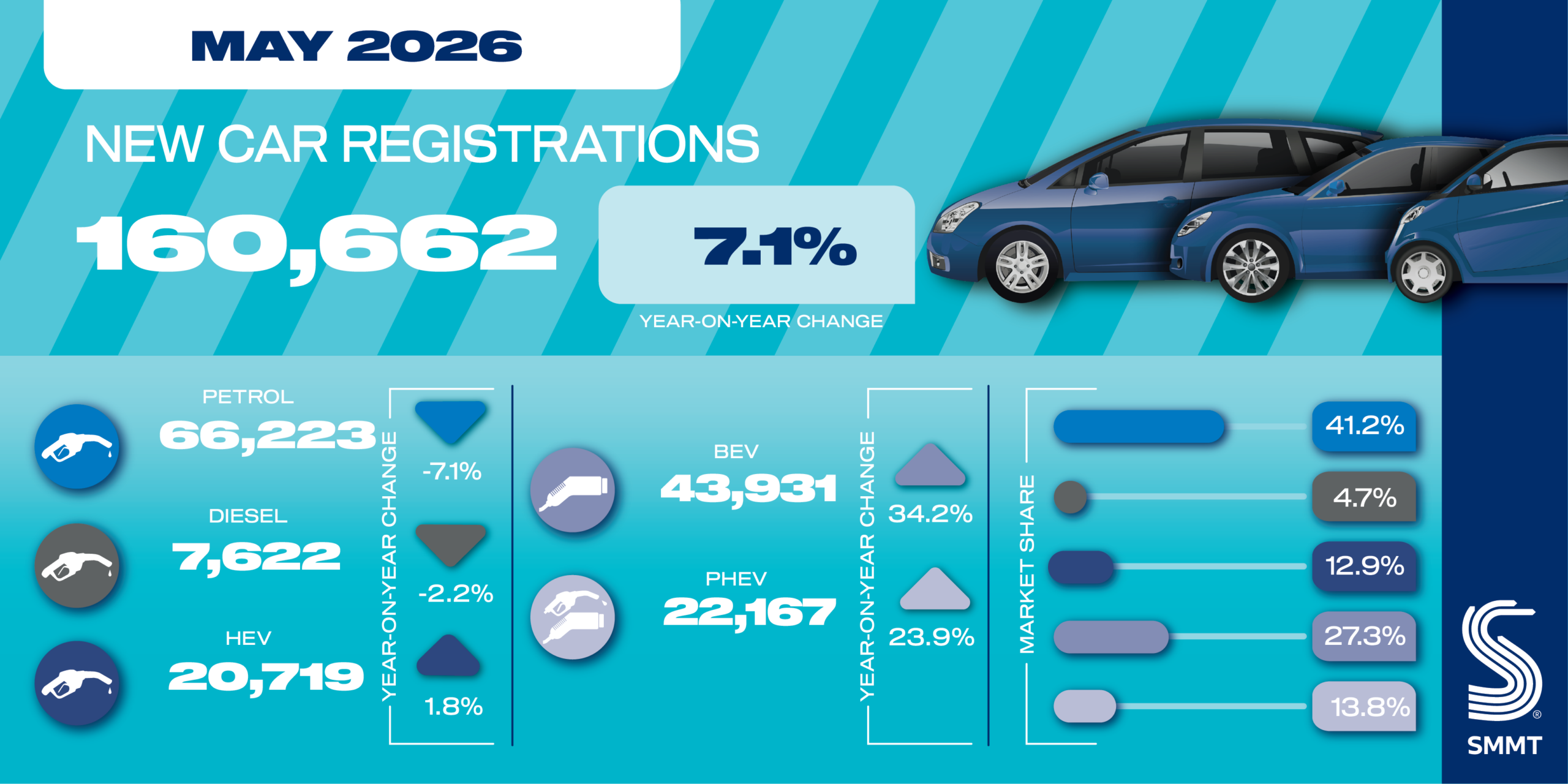
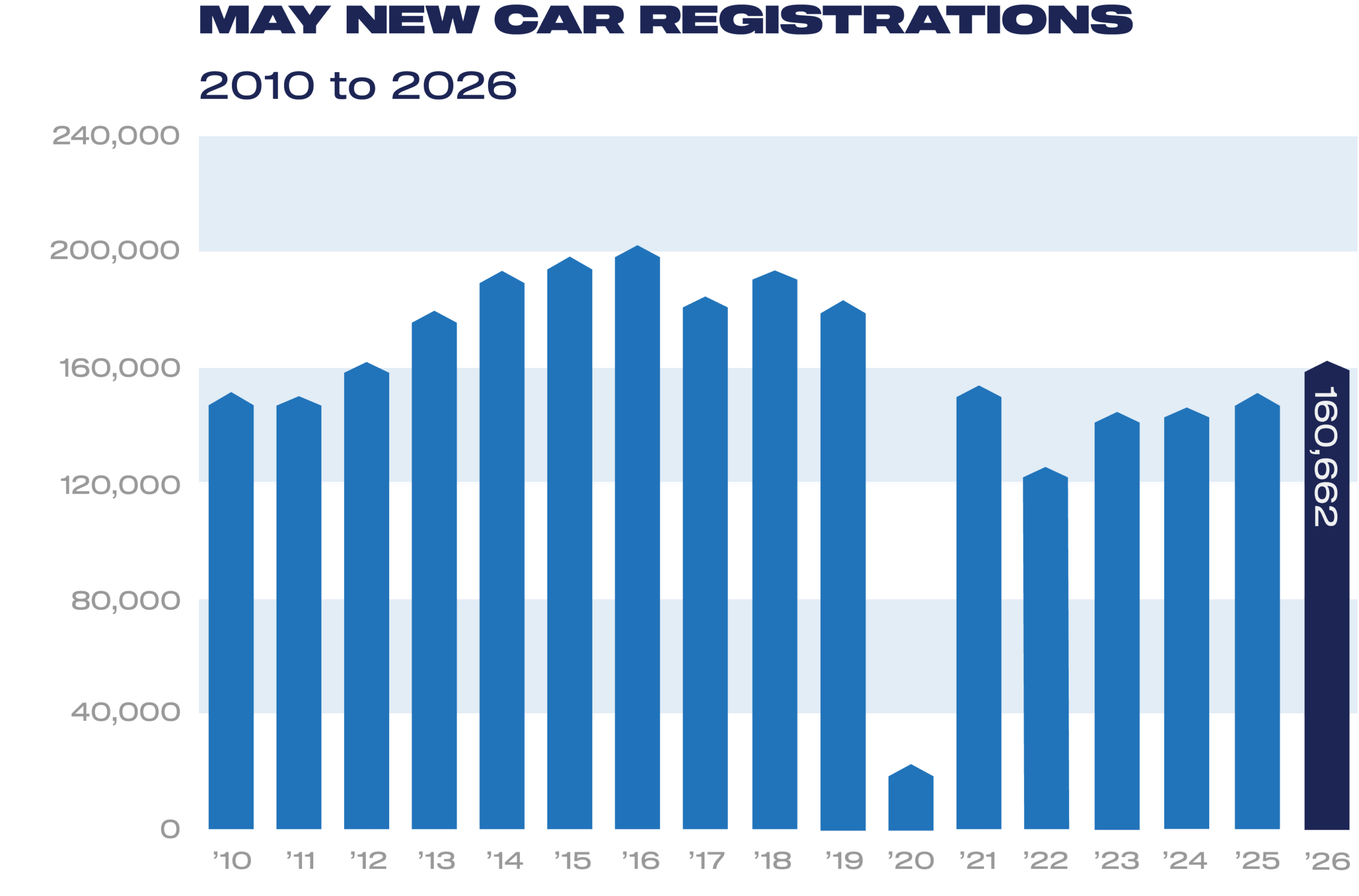
The UK’s new car market delivered its strongest May performance since before the pandemic, with registrations rising 7.1% to 160,662 units, according to the latest figures from the Society of Motor Manufacturers and Traders (SMMT). The performance was the best recorded for the month since 2019, although still -12.6% behind pre-pandemic levels.1
A resurgence in private buyers drove the increase, with registrations up 17.2% as consumers responded to increasingly competitive offers from an unprecedented range of brands and a 6.4% increase in model choice – including a 25.6% uplift in BEV products year to date2 Fleet demand grew more modestly, rising 1.8% but still accounted for more than half (57.1%) of all registrations. The smaller business sector declined -18.8%, although in volume terms the drop was marginal (720 units).
The gradual shift in consumer demand for new technologies continues to reshape the market. Registrations of petrol and diesel cars fell by -7.1% and -2.2% respectively, as electrified vehicles gained ground. Hybrid electric vehicle (HEV) uptake rose 1.8% and plug-in hybrid deliveries grew 23.9% to take an enlarged 13.8% market share. Battery electric vehicle (BEV) uptake, meanwhile, increased 34.2% to take 27.3% of the market, the highest recorded so far in 2026.
The uplift reflects both expanding model choice and sustained competition, particularly in the electric vehicle market where substantial manufacturer discounting continues to play a significant role in driving uptake. Government support, including the Electric Car Grant, has also helped stimulate demand, alongside rising consumer interest amid wider economic and geopolitical uncertainty.
Despite recent momentum, however, the transition to zero-emission mobility remains well behind the mandated trajectory. Year-to-date, BEVs account for just 23.9% of the market, well short of the 33% required in 2026. While various flexibilities can be drawn upon to help meet the regulation, this widening gap between mandated targets and consumer demand is increasing pressure on manufacturers which must try to absorb the rising costs of compliance.
In the seventh Carbon Budget, published this week, Government envisages EVs comprising 95% of the new UK car and van market by 2030 – an ambition well beyond the targets set by the mandate of 80% for cars and 70% for vans. If such targets are to be credible (and a tripling of EV demand in three years is highly unlikely under current outlooks) then equally ambitious fiscal and investment support would be essential. A holistic review of the transition is urgently needed, therefore, else the investment proposition of the UK is undermined, consumer choice constrained, and the pace of fleet renewal – essential to cutting road transport emissions – curtailed.
Mike Hawes, SMMT Chief Executive
Britain’s car buyers are responding to a market offering more choice than ever, from both new and familiar brands, resulting in a robust May. The EV transition is progressing, but consumer uptake still lags behind even today’s targets, let alone the ambition set out in the latest Carbon Budget.
While industry shares the long-term ambition, the pathway to Net Zero must be credible. It cannot come at the cost of lost competitiveness and deindustrialisation. A review of the transition is now urgent to ensure ambition matches market realities and we have a sustainable path to road transport decarbonisation.
Notes to editors
- May 2019 registrations: 183,724 units
- A net total of 21 additional models received at least one registration in May 2026 compared with May 2025. 31 new BEV models have received registrations YTD.
SMMT Update
Sign up
Sign up to the SMMT Update Newsletter for weekly automotive news and data
"*" indicates required fields