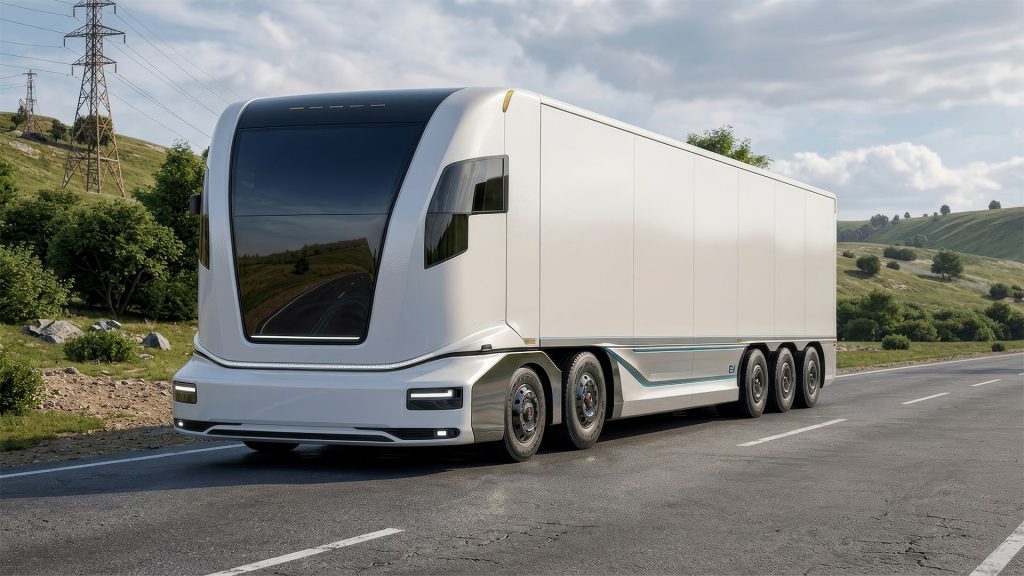
A recent study by the Road Haulage Association (RHA) found that the UK logistics industry will require 40,000 new HGV drivers annually for the next five years, due to growing demand and possible future driver shortages.
Although operators and training companies are having success bringing through new recruits, the development of autonomous commercial vehicles offers a potential solution to ease the problem.
Proponents of driverless vehicles say they offer a route to higher utilisation, reduced labour dependency and improved efficiency that could deliver transformational cost savings and productivity gains.
Last month, eFREIGHT Autonomous, a consortium of experts in commercial vehicles and automotive technology, published the findings of a nine-month long study into the emerging technology.
The report identified hub-to-hub motorway trunking between logistics centres, as well as short intermodal shuttle operations linking ports, railheads and distribution hubs, as the most viable starting points for early UK deployment.
According to the consortium, these operations provide the clearest commercial and operational pathway because routes are predictable, interfaces can be controlled and benefits can be measured around productivity, utilisation, safety and emissions.
Sir Vince Cable, Chair of the eFREIGHT Autonomous Consortium, said: “The UK now has a genuine opportunity to help shape the future of autonomous freight rather than simply importing solutions developed elsewhere.
“The next step is to move from feasibility work towards structured real-world deployment trials.”
Led by Voltempo, alongside Connected Places Catapult and Berkeley Coachworks, the consortium secured funding in 2025 through the UK Government-backed CAM Pathfinder Feasibility Studies competition delivered by Innovate UK and Zenzic.
Since then, it has carried out workshops, seminars and customer visits with operators across the freight sector, while engaging with every major European truck manufacturer, alongside the Department for Transport (DfT), the Department for Business and Trade, Transport Scotland, Logistics UK, the Road Haulage Association (RHA) and the Society of Motor Manufacturers and Traders (SMMT).
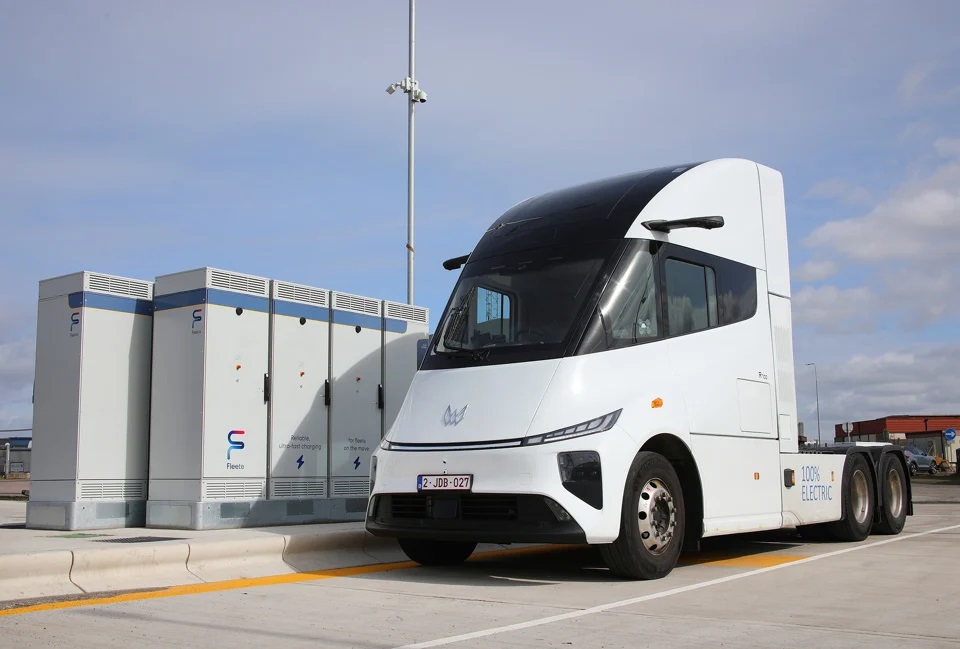
Voltempo is also working with fleet operators, OEMs and government to define real-world use cases, safety frameworks and commercial models for autonomous freight deployment.
In addition, it is designing and delivering UK trials, shaping regulation, and building the operational infrastructure required to support autonomous HGVs at scale.
Meanwhile, Voltempo and its partners are working with government and OEMs on concepts for a new category of autonomous HGV, including lightweight “smart trailer” configurations capable of delivering 15% greater payload while reducing overall vehicle weight by about 10%.
The consortium believes these vehicle concepts could ultimately remove more than 22,000 heavy vehicles from UK roads while reducing fleet operating costs by up to 37%.
Michael Boxwell, Corporate Development Officer at Voltempo, said: “Over the past nine months, we’ve focused on understanding where autonomous freight can deliver genuine operational value for UK fleets and what conditions are needed to make deployment practical.
“The technology, legislation and commercial interest are all moving forward quickly, and with continued grant funding available to support trials, the UK is ideally positioned to take advantage and lead from the front.”
Other UK projects which have received funding from the CAM Pathfinder programme include RAMP Ready, an auto-cargo autonomous cargo dolly; Sim4CAMSens2, which is validating new areas to improve sensor modules; and P-Cal, a proof-of-concept for an autonomous container transport system at the Port of Tyne.
As part of the programme, a consortium member – Berkeley Coachworks – is developing autonomous HGVs in parallel at its manufacturing site in Pembrokeshire.
Ben Garratt, Logistics UK’s Deputy Director, Public Affairs, said the funding of such schemes is a welcome step towards realising the potential of autonomous vehicles.
“Autonomous technology has the potential to make logistics safer, more efficient and more attractive to work in”, he added.
In the UK, deployment has so far been largely limited to depots and intermodal hubs, reflecting the constraints of existing legislation.
However, forthcoming regulatory changes under the Automated Vehicles Act 2024 are expected to enable a broader set of use cases beyond confined sites, with autonomous freight moving rapidly from pilot projects into early commercial operation.
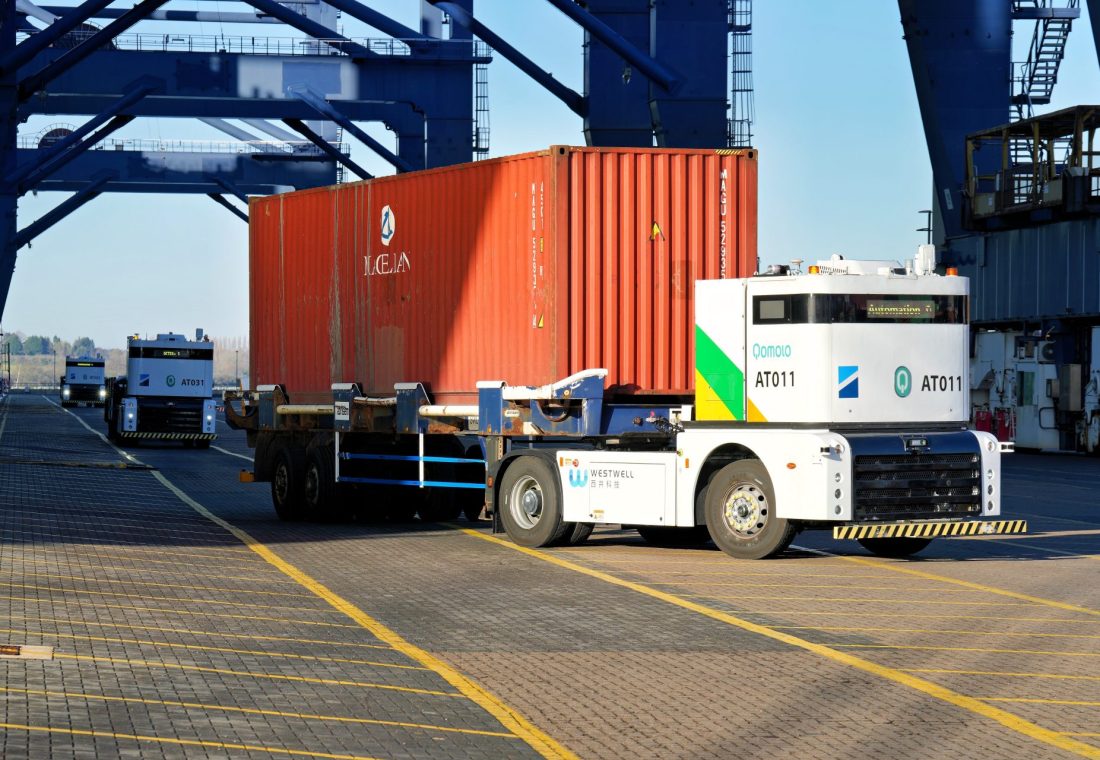
Early examples of such vehicles being operated include autonomous cargo handling at East Midlands Airport, as well as the Port of Felixstowe successfully deploying 68 Westwell commercial autonomous yard tractors at its Trinity Terminal alongside conventionally driven trucks in mixed traffic mode operation.
These vehicles are fully electric and emissions-free as the port has used only electricity certified as being from renewable sources since April 2023.
They are equipped with 128-line LiDAR, 360-degree camera vision, monocular and stereo cameras with radar.
An automated battery swap station also allows the autonomous vehicles to exchange depleted power units for fully charged ones in five to six minutes – without manual intervention.
Thanks to the port’s private 5G network, there is fast, reliable and secure communication and control systems for the driverless vehicles as well as for a wide range of conventional equipment.
The report highlights that autonomous vehicles in these environments have demonstrated high-precision manoeuvring, integration with live operations and delivery of real productivity and decarbonisation benefits.
Clemence Cheng, Executive Director of Hutchison Ports and Port of Felixstowe CEO, said: “The continued scaling up of this project has been made possible by the recent introduction of a private 5G network at the Port of Felixstowe.
“As well as improving operational consistency and efficiency, the increased use of battery-powered autonomous trucks will significantly support our ambition to achieve Net-Zero for Scope 1 and 2 emissions by 2035.”
The report found that autonomous heavy road freight has the potential to transform the UK logistics industry in a short space of time.
Decisions taken over the next few years will influence where deployment occurs, who benefits, and how risks and impacts are managed.
Early adoption will be shaped as much by regulation, infrastructure readiness, safety assurance and commercial models as by vehicle technology itself.
However, autonomous freight technology is here to stay, and operators that engage at an early stage will help shape the market and be well placed to stay ahead of their competitors.