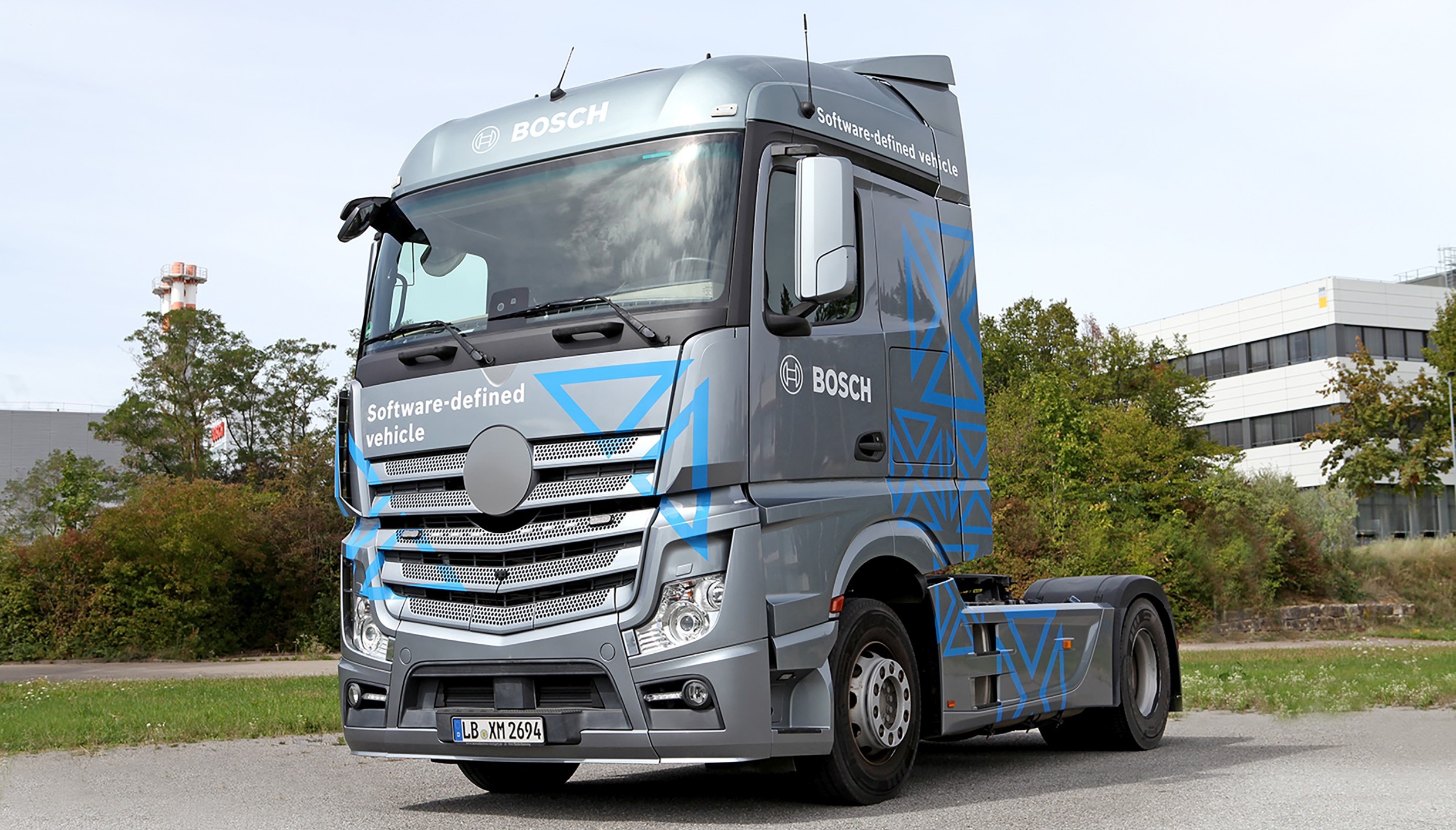
How is Bosch technology helping with the development of software-driven commercial vehicles?
Modern commercial vehicles are collecting and processing increasing amounts of data, and the ever-expanding range of powertrain, assistance, and automation functions is leading to much greater complexity in electrical and electronic systems.
Bosch and subsidiary ETAS are developing central electrical/electronic (E/E) architectures, featuring high-performance, scalable vehicle computers and the associated software platforms.
As a result, customers are benefiting from Bosch’s systems expertise, as we are well-versed in both hardware and software. Software-defined mobility in the trucking business addresses the industry’s most critical factor: total cost of ownership.
For fleet operators, the software-defined truck significantly reduces day-to-day complexity.
What about the safety technology Bosch produces
Bosch’s portfolio ranges from hardware and software to artificial intelligence and cloud-based services that make operating commercial vehicles safer and more economical.
In 2027, we will launch a new generation of our multipurpose camera and radar sensor, both of which will enable precise detection of people and vehicles, thanks to the latest AI technologies and significantly greater computing power.
A digital rearview mirror with a built-in camera that analyses driver behaviour and issues warnings when it senses driver distraction went into mass production in 2026 at two well-known European manufacturers.
With our comprehensive portfolio of systems and sensors, Bosch helps create a complete view of the truck’s surroundings and enhances driving safety and convenience. Thanks to intelligent software algorithms, data from the various sensors in the vehicle is combined and analysed in real time.
The cameras and radar systems are also suitable for higher levels of automation. Level 4 automated driving is the goal, in part to address the driver shortage in the logistics sector. The software can handle increasingly complex driving tasks, thus reducing the burden on the logistics system.
Tell us about Bosch’s growth strategy
A key element of our growth strategy remains our broad portfolio of alternative powertrain technologies. In 2026, one-third of all newly registered battery-electric trucks in Europe are powered by electric motors and inverters from Bosch. A major new order from long-time partner Daimler Truck for the eActros electric truck underpins this success and the agreement covers the supply of electric powertrain components manufactured in Europe.
The heavy-duty commercial vehicle business is a key growth area for us, and we aim to double our sales in this segment by the mid-2030s.
What about the other technologies when it comes to decarbonisation?
Achieving the world’s climate goals in the transport sector isn’t an ‘either-or’ proposition – we have to use every technology that helps us transition away from fossil fuels.
That’s why Bosch consistently focuses on technological diversity and, in addition to fuel-cell power modules, also supplies key components for hydrogen-powered combustion engines.
At the same time, we intend to systematically expand our leading position in diesel engines and continue to optimise conventional injection systems to help vehicle manufacturers meet new emissions standards such as Euro-7.
For the global fleet, renewable synthetic fuels can also help make rapid progress toward climate goals.

Dr. Markus Heyn
Deputy Chairman of the Bosch Board of Management and Chairman of the Mobility Business Sector
What UK commercial vehicle manufacturing needs to flourish
1 Oct 2026Five Minutes With… Dr. Markus Heyn, Deputy Chairman of the Bosch Board of Management and Chairman of the Mobility Business Sector
1 Oct 2026