

What is the motor industry doing to stop global warming?
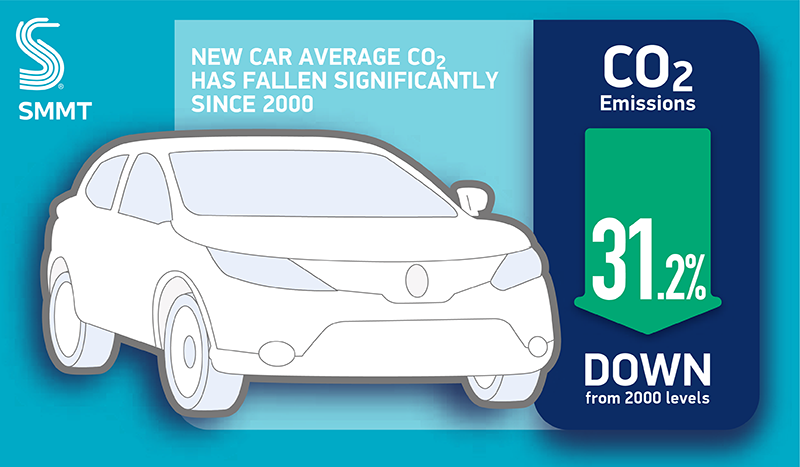
During the last decade, the UK motor industry has made progress against a wide range of environmental indicators, new car CO2 emissions, total energy consumed and CO2 emitted from manufacturing. You can learn more by downloading the annual SMMT Sustainability Report and the SMMT New Car CO2 report.
Wouldn’t it be better if we stopped making new vehicles?
The majority of life cycle CO2 emissions of a vehicle come from the use phase. That is, 10% comes from production, 85% from the use phase and 5% from recycling. In the last decade, CO2 emitted from the tailpipe has reduced by 22% to 2010.
What is the industry doing to reduce emissions from vehicles?
Industry has reduced tailpipe CO2 emission by 22% in the last decade to 2010. The improvement in performance can be attributed to a number of factors. In recent years, vehicle manufacturers have been investing huge resources in developing lower emitting vehicles and technologies. Industry is looking forward to a 25% reduction in new car CO2 through the European Commission Regulation, to 130g/km by 2012-15, with an additional 10g/km from ‘complementary measures’.
When are we going to see alternative fuels?
Alternative fuels are available today. Flex-fuel vehicles which run on E85 (85 per cent bio-ethanol/15% fossil fuel blend) can be purchased from car showrooms now. Conventional fuels in the market are currently 5% biofuel for petrol (EN228) and 7% for diesel (EN590). Some manufacturers are also working on the use of hydrogen as an alternative to diesel and petrol as well as electric. Registrations of alternatively fuelled vehicles rose by 52.8% in 2010 to 22,865 units. This is 64 times the number in 2000.
How many vehicles are recycled every year?
Under the End of Life Vehicle Directive, in place since 2007, every car which comes to the end of its life can be recycled free of charge to the customer at an Authorised Treatment Facility. This means that up to 95% of the weight of the vehicle will be recycled and reused.
Should manufacturers recycle every vehicle free of charge?
It is now the manufacturers’ responsibility to recycle all cars which have come to the end of their use, under the End of Life Vehicle directive if there is a cost. The consumer should take their vehicle to an authorised treatment facility, where they will be presented with a certificate of destruction.
What does sustainability mean to the motor industry?
The motor industry sees sustainability as a commitment to the environmental, economical and social welfare of everyone working both in the sector and those affected by it. Each year SMMT reports on this through its annual Sustainability Report.
Why are we still using petrol and diesel to fuel vehicles?
All manufacturers are working to develop alternative powertrains. However in the interim conventional engines are more fuel efficient than ever before and Euro engine emission standards introduced in the early 1990s have led to significant improvements in emissions of nitrogen oxides, particulates and hydrocarbons from passenger cars, vans and trucks. Since 1992, NOx emissions have been reduced by around 67% and diesel particulates have dropped by 94%.
This site uses cookies. By using the site, you are consenting to this. Find out why we use cookies and how to manage your settings by clicking on our Cookies Notice.
Environment Q&A
What is the motor industry doing to stop global warming?
During the last decade, the UK motor industry has made progress against a wide range of environmental indicators, new car CO2 emissions, total energy consumed and CO2 emitted from manufacturing. You can learn more by downloading the annual SMMT Sustainability Report and the SMMT New Car CO2 report.
Wouldn’t it be better if we stopped making new vehicles?
The majority of life cycle CO2 emissions of a vehicle come from the use phase. That is, 10% comes from production, 85% from the use phase and 5% from recycling. In the last decade, CO2 emitted from the tailpipe has reduced by 22% to 2010.
What is the industry doing to reduce emissions from vehicles?
Industry has reduced tailpipe CO2 emission by 22% in the last decade to 2010. The improvement in performance can be attributed to a number of factors. In recent years, vehicle manufacturers have been investing huge resources in developing lower emitting vehicles and technologies. Industry is looking forward to a 25% reduction in new car CO2 through the European Commission Regulation, to 130g/km by 2012-15, with an additional 10g/km from ‘complementary measures’.
When are we going to see alternative fuels?
Alternative fuels are available today. Flex-fuel vehicles which run on E85 (85 per cent bio-ethanol/15% fossil fuel blend) can be purchased from car showrooms now. Conventional fuels in the market are currently 5% biofuel for petrol (EN228) and 7% for diesel (EN590). Some manufacturers are also working on the use of hydrogen as an alternative to diesel and petrol as well as electric. Registrations of alternatively fuelled vehicles rose by 52.8% in 2010 to 22,865 units. This is 64 times the number in 2000.
How many vehicles are recycled every year?
Under the End of Life Vehicle Directive, in place since 2007, every car which comes to the end of its life can be recycled free of charge to the customer at an Authorised Treatment Facility. This means that up to 95% of the weight of the vehicle will be recycled and reused.
Should manufacturers recycle every vehicle free of charge?
It is now the manufacturers’ responsibility to recycle all cars which have come to the end of their use, under the End of Life Vehicle directive if there is a cost. The consumer should take their vehicle to an authorised treatment facility, where they will be presented with a certificate of destruction.
What does sustainability mean to the motor industry?
The motor industry sees sustainability as a commitment to the environmental, economical and social welfare of everyone working both in the sector and those affected by it. Each year SMMT reports on this through its annual Sustainability Report.
Why are we still using petrol and diesel to fuel vehicles?
All manufacturers are working to develop alternative powertrains. However in the interim conventional engines are more fuel efficient than ever before and Euro engine emission standards introduced in the early 1990s have led to significant improvements in emissions of nitrogen oxides, particulates and hydrocarbons from passenger cars, vans and trucks. Since 1992, NOx emissions have been reduced by around 67% and diesel particulates have dropped by 94%.